
Heat Stress Monitor Market Size, Status, Top Players, Trends By 2030

The surging need to monitor heat stress of athletes and military personnel, owing to the adverse impacts of heat on the performance of individuals, is expected to propel the heat stress monitor market at a CAGR of 2.7% during 2020–2030. The market revenue stood at $51.4 million in 2019 and it is projected to reach $62.5 million by 2030. These instruments help military personnel and athletes in tracking the heat stress limits by providing real-time information about their health.

In the recent past, portable/handheld heat stress monitors were preferred over fixed variants due to the dynamic nature of the former. Portable/handheld variants are used to monitor the intensity of heat stress in several conditions, ranging from underground mines to industrial settings. Both these types of heat stress monitors are equipped with air flow, dry bulb, globe thermometer, humidity, and natural wet bulb sensors.
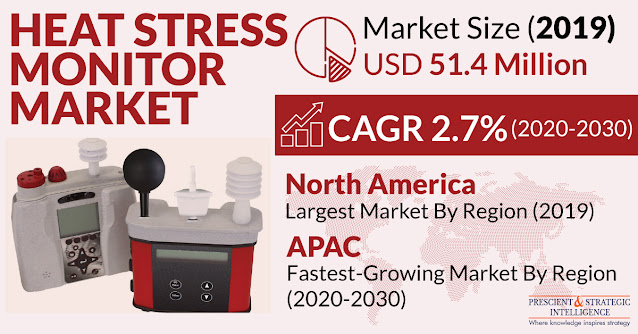

Among the various types of sensors, enormous volumes of globe thermometer sensors are being increasingly adopted in the oil and gas, manufacturing, and mining sectors due to their high accuracy and exceptional durability. According to P&S Intelligence, North America led the heat stress monitor market in the preceding years, owing to the presence of stringent government guidelines on the safety of employees who are exposed to high temperatures. 

For example, the National Institute for Occupational Safety and Health (NIOSH) and the OSHA mandate the use of heat stress monitors in the petrochemical, oil and gas, mining, chemical, and industrial manufacturing sectors of the U.S. Additionally, the upcoming 2026 FIFA World Cup will also create a huge requirement for such devices in the U.S., Canada, and Mexico.

Further, the Asia-Pacific (APAC) region will also adopt a considerable number of heat stress monitors in the forthcoming years due to the rising number of production units in developing countries, such as Vietnam, Thailand, China, Indonesia, and India. For example, the India Brand Equity Foundation (IBEF) estimates that approximately 12% of the Indian population is employed in the manufacturing sector of the country. 

To reduce heat stress among this large populace, the Ministry of Labor and Employment, Government of India, has drafted the 2018 Labor Code on Occupational Safety, Health and Working Conditions. Therefore, the soaring need to monitor heat stress of military personnel and sportspersons and the increasing focus of governments on preserving the health of working professionals will create a huge requirement for heat stress monitors globally.

Comments

Popular posts from this blog

Edge Data Center Market To Generate $53.1 Billion Revenue by 2030

A number of factors such as the commercialization of 5G, high demand for internet of things (IoT) devices, and dense over-the-top (OTT) and mobile data traffic are expected to drive the edge data center market at a CAGR of 25.4% during the forecast period (2020–2030). The market revenue stood at $5.3 billion in 2019, and it is projected to reach $53.1 billion by 2030.  In recent years, the rising adoption of IoT technology in the healthcare and automotive industries has become a major market trend. The increasing mobile data traffic is a prominent growth driver of the edge data center market across the world. The growing usage of smartphones and IoT devices is resulting in the generation of high volumes of data.  Get the Sample Copy of this Report @ https://www.psmarketresearch.com/market-analysis/edge-data-center-market-analysis/report-sample To manage the mounting amount of data, umpteen edge data centers are being deployed across the world. The rising penetration of the in...

Digital Signature Market To Generate $25,211.3 Million Revenue by 2030

Factors such as the surge in adoption of digital-signature based biometrics in the banking, financial services and insurance (BFSI) sector, requirement for advanced security solutions amidst pandemic lockdowns and remote working environment, government policies regarding digitization and data protection, and rise in usage of digital signature to eliminate paperwork are expected to drive the growth of the digital signature market at a CAGR of 29.2% during the foreseeable period. According to P&S Intelligence, the market size is projected to reach $25,211.3 million by 2030 from $1,858.3 million in 2020. Moreover, the market is witnessing a trend of using digital signatures in the healthcare industry for higher transparency. The surging adoption of digital-signature-based iometrics in the BFSI sector is one of the main factors boosting the digital signature industry growth. Biometrics is one of the most secure ways of authentication and identification, as this technology offers a uniq...

Robotic Process Automation Market Drivers, Restraints, Opportunities, and Trends in Coming Years

Robotic process automation solutions allow businesses to create virtual workforce, which can work on routine and mundane tasks with high efficiency, thereby eliminating the requirement for manual intervention. These solutions offer scalability and reduce operational cost by over 50%, as the virtual workforce can work round the clock. As the RPA systems can work continuously, they offer enhanced customer satisfaction. With the growing complexities in operations, enterprises across the world are adopting automated solutions, interaction solutions, and decision support and management solutions to automate repetitive and mundane tasks. Apart from this, RPA software also helps in mechanizing back-end processes because it can run in the background 24*7. This, in turn, allows human employees to concentrate on more important tasks, such as product development or client handling. Get the Sample Copy of this Report @ https://www.psmarketresearch.com/market-analysis/robotic-process-automation-ma...